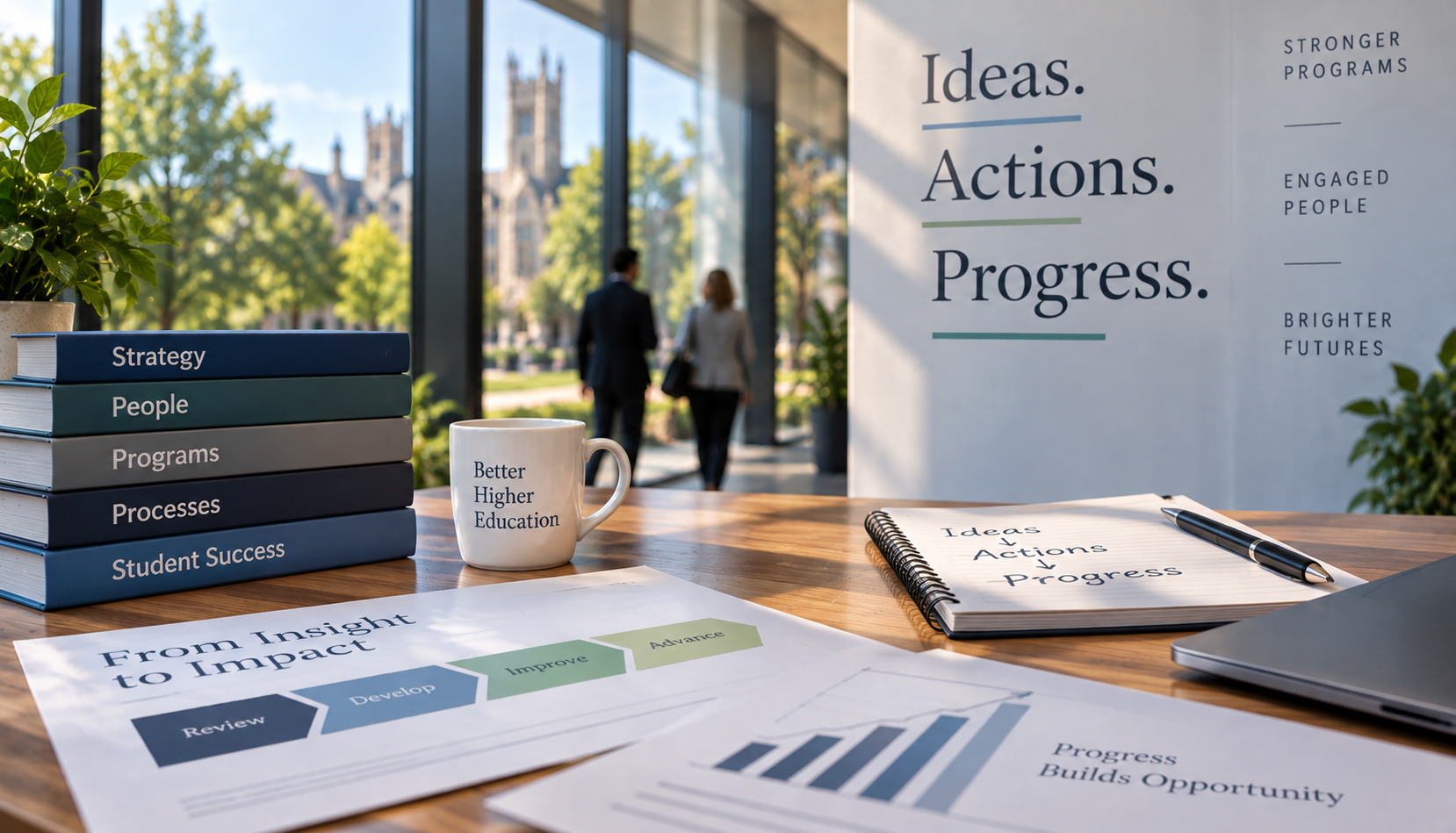
From Recommendations to Results: Why Follow-Through Matters
From Recommendations to Results: Why Follow-Through Matters
Higher education institutions rarely lack ideas, plans, or recommendations. The greater challenge is turning priorities into action, maintaining momentum, and creating visible evidence of continuous improvement.
Higher education institutions generate a significant amount of thoughtful work. Strategic plans are developed. Academic programs are reviewed. Committees make recommendations. Faculty identify opportunities for improvement. Leaders establish priorities and new initiatives are proposed.
Yet identifying what should improve and actually moving that improvement forward are two different things.
The challenge is often not a lack of knowledge or commitment. It is maintaining the capacity, ownership, coordination, and momentum required to move from recommendation to implementation.
Why Good Recommendations Can Lose Momentum
Institutional priorities rarely exist in isolation. Academic leaders, faculty, and professional staff are simultaneously managing teaching, students, programs, operations, reporting requirements, new initiatives, and unexpected challenges.
As a result, even well-supported recommendations can gradually lose momentum.
A review may identify important curriculum improvements, but responsibility for the next step remains unclear. A faculty development initiative may generate enthusiasm but receive little follow-up. A strategic priority may be approved without establishing how progress will be tracked.
Current higher education research also points to the broader capacity challenge. EDUCAUSE's 2026 workforce research describes a cycle in which increasing complexity, staffing pressures, and limited resources can push institutional teams toward short-term responses, leaving less capacity for sustained improvement.
This makes follow-through an institutional capability in its own right.
Five Practices That Help Turn Recommendations Into Results
Prioritize What Matters
Not every recommendation needs to be addressed at once. Institutions can create greater momentum by identifying the actions that matter most and sequencing improvement work realistically.
Create Clear Ownership
Priorities are more likely to move forward when responsibility is clear. Institutions should know who will lead an action, who needs to contribute, and who will review progress.
Translate Ideas Into Actions
Broad recommendations become more useful when converted into practical next steps with reasonable timelines, responsibilities, and expected outcomes.
Document the Progress
Institutions often complete meaningful improvement work without creating a clear record of what changed, why it changed, and what evidence demonstrates progress.
Review & Adjust
Implementation should generate new learning. Institutions need opportunities to review results, identify what is working, reconsider assumptions, and determine the next priority.
Continuous Improvement Is a Cycle
Continuous improvement becomes more useful when it is understood as an ongoing institutional practice rather than a project with a final endpoint.
Research on continuous improvement in higher education has emphasized systematic cycles in which institutions identify opportunities, implement actions, evaluate results, and use what they learn to guide subsequent improvements.
The important element is the connection between each stage.
Review without action produces information. Action without review can produce activity without clear direction. Improvement becomes more meaningful when institutions connect evidence, decisions, implementation, and reflection.
Small Improvements Can Create Meaningful Momentum
Continuous improvement does not always require institution-wide transformation.
In many cases, meaningful progress begins with focused changes.
An academic program may clarify its learning outcomes. Faculty may redesign an assessment. A department may improve how it documents decisions. An institution may establish a more structured approach to AI. A leadership team may identify three priorities rather than attempting to advance fifteen.
Individually, these actions may appear modest. Over time, however, focused improvements can strengthen programs, practices, institutional capability, and decision-making.
The objective is not to create constant change. It is to create a manageable rhythm of purposeful improvement.
Documenting Improvement Matters
One of the most easily overlooked parts of institutional improvement is documentation.
Institutions frequently do more improvement work than their records make visible.
Faculty revise courses. Leaders make decisions. Programs respond to findings. Professional development takes place. New practices are introduced. But when those activities are not connected and documented, the institution can lose part of the value of the work.
A useful improvement record can capture:
- The priority or issue that was identified
- The evidence or discussion that informed the decision
- The recommendation or intended improvement
- The actions that were taken
- Who participated or held responsibility
- Faculty or leadership development connected to the work
- Evidence of implementation or progress
- What was learned from the process
- What should happen next
Documentation should not become an administrative exercise for its own sake. Its purpose is to help the institution retain knowledge, demonstrate progress, support decision-making, and build on previous work.
Data Matters—But Data Does Not Implement Change
Data and evidence are essential to institutional effectiveness. They help leaders understand performance, identify patterns, evaluate outcomes, and make more informed decisions.
But data alone does not create improvement.
Research on data-driven continuous improvement in higher education has similarly found that data is a tool rather than a solution by itself. Leadership commitment, resources, organizational culture, and the ability to act on evidence remain critical.
The practical question is therefore not simply whether an institution collects information.
It is whether the institution has a process for turning that information into decisions, action, learning, and subsequent improvement.
Follow-Through Requires Capacity
One reason institutional priorities stall is straightforward: people are busy.
The same academic and administrative leaders responsible for improvement initiatives are often responsible for numerous operational priorities. Faculty likewise balance teaching, student support, service, scholarship, and program responsibilities.
This means institutions should think realistically about the capacity required to sustain improvement.
Sometimes the answer is better prioritization. Sometimes it is clearer ownership or stronger internal coordination. In other situations, institutions may benefit from additional expertise or external support to help carry particular workstreams forward.
The important point is that implementation requires attention. A recommendation does not become reality simply because everyone agrees that it is important.
A Question for Institutional Leaders
Consider the reviews, plans, discussions, and priorities already within your institution:
What important recommendations or priorities do you already know about—but have not yet had the capacity to move forward?Make Progress Visible
Strong institutions are not those that never need to improve.
They are institutions that develop the ability to recognize opportunities, make thoughtful decisions, act on priorities, learn from implementation, and continue moving forward.
That requires more than plans and recommendations.
It requires a connection between what the institution knows, what it decides, what it does, and what it learns.
When those elements become part of an ongoing institutional rhythm, continuous improvement becomes more than an aspiration.
It becomes visible progress.
References
Association for Institutional Research. (2025). 2024 AIR National Survey: IR/IE office work. Association for Institutional Research .
Dalal, N. (2019). Don't stop improving: Supporting data-driven continuous improvement in college student outcomes. Institute for College Access & Success. ERIC .
EDUCAUSE. (2026). 2026 EDUCAUSE workforce report: Can higher education break the cycle of reactivity? EDUCAUSE Library .
Samuel, S., & Farrer, H. (2025). Integrating the PDCA cycle for continuous improvement and academic quality enhancement in higher education. Journal of Comparative & International Higher Education, 17(2), 115–124. ERIC .
Temponi, C. (2005). Continuous improvement framework: Implications for academia. Quality Assurance in Education, 13(1), 17–36. ERIC .
Volkwein, J. F. (2010). A model for assessing institutional effectiveness. New Directions for Institutional Research, 13–28. ERIC .
Ready to Move a Priority Forward?
Riveral Advisory helps higher education institutions turn reviews, recommendations, and institutional priorities into structured activity, documented improvement, and visible progress.
Start a Conversation